
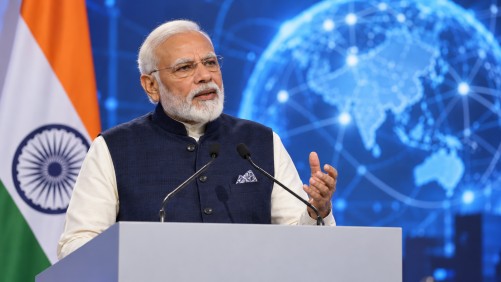
At the Indian Mobile Congress in New Delhi, Prime Minister Narendra Modi underscored the pressing need for a global mechanism to pre-empt cyber fraud, urging for enhanced international cooperation among governments, telecom operators, and financial institutions. Highlighting the transnational nature of cybercrime, Modi emphasized that criminals exploit networks across various jurisdictions to target individuals in different countries. He called on the GSMA and telecom companies to develop a coordinated system to detect and stop fraudulent activities early.
Modi’s call to action follows a recent declaration by BRICS member countries, which expressed concerns over organized scam networks and cross-border financial fraud. The declaration stressed the importance of stronger collaboration among law enforcement agencies, financial intelligence units, customs authorities, and technology platforms to identify suspicious transactions and combat money laundering.
Reports indicate that scam operations in regions such as Cambodia, Myanmar, and Laos are linked to various online fraud tactics, including impersonation scams, fake investment platforms, and loan-related extortion. Alarmingly, these operations have also been associated with human trafficking, where individuals are deceived by false job offers and coerced into criminal activities.
In India, cybercrime has become an escalating financial concern. Government data presented in Parliament revealed that losses from cybercrime rose significantly from ₹7,465 crore in 2023 to ₹22,845 crore in 2024, underscoring the urgent need for improved preventive measures, public awareness, and faster coordination among authorities.
During his speech, Modi also highlighted India’s digital transformation achievements, including the expansion of mobile connectivity, digital banking, and direct benefit transfers. He noted that these advancements have enhanced access to government services, education, healthcare, and financial assistance. Modi pointed out that direct benefit transfers have delivered approximately ₹50 lakh crore to beneficiaries through digital-linked bank accounts, preventing around ₹5 lakh crore in potential leakages. He highlighted schemes like PM-Kisan, where over ₹4 lakh crore has been transferred to farmers.
Furthermore, Modi urged India to transcend its role as a consumer of digital technology and focus on developing its own products, research capabilities, and intellectual property. He cited progress in semiconductor manufacturing and called for the next phase of the telecom sector to foster investment, innovation, exports, and domestic technology development. He envisioned the Indian Mobile Congress as a key platform for advancing research, manufacturing, and technological innovation while reinforcing digital security and international collaboration.