
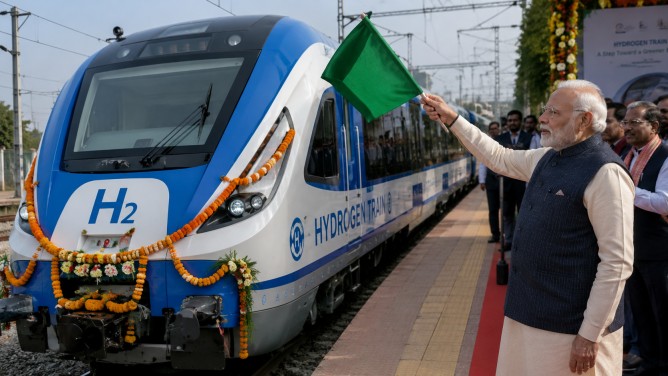
In a landmark move towards eco-friendly rail travel, India has unveiled its inaugural hydrogen fuel cell-powered train. This initiative, which Prime Minister Narendra Modi inaugurated in Jind, Haryana, symbolizes a significant advancement in the country’s pursuit of green energy solutions for transportation.
The ambitious project involves the establishment of an integrated hydrogen production setup, a dedicated refuelling station, and a locomotive driven by a hydrogen fuel cell. Hydrogen is generated on-site with the help of an electrolyzer, then it is compressed, stored, and carefully transferred to the train at a specialized refuelling station.
This refuelling infrastructure is equipped with high-pressure compressors and hydrogen dispensers, along with an automated platform that oversees the entire fuel management process. This system ensures that hydrogen is compressed, stored, and dispensed safely, maintaining operational safety throughout the refuelling operations.
Officials have emphasized that this development underscores India’s expanding expertise in creating homegrown hydrogen infrastructure, aligning with the nation’s National Green Hydrogen Mission. There are plans to implement similar hydrogen refuelling systems on several heritage railway routes, such as the Darjeeling Himalayan Railway, Kalka-Shimla Railway, and Nilgiri Mountain Railway.
Hydrogen fuel cell trains operate by generating electricity through a chemical reaction between hydrogen and oxygen, with the only emission being water vapor. This innovation presents a cleaner alternative to traditional diesel trains and is poised to significantly contribute to the reduction of carbon emissions within the transportation sector.