
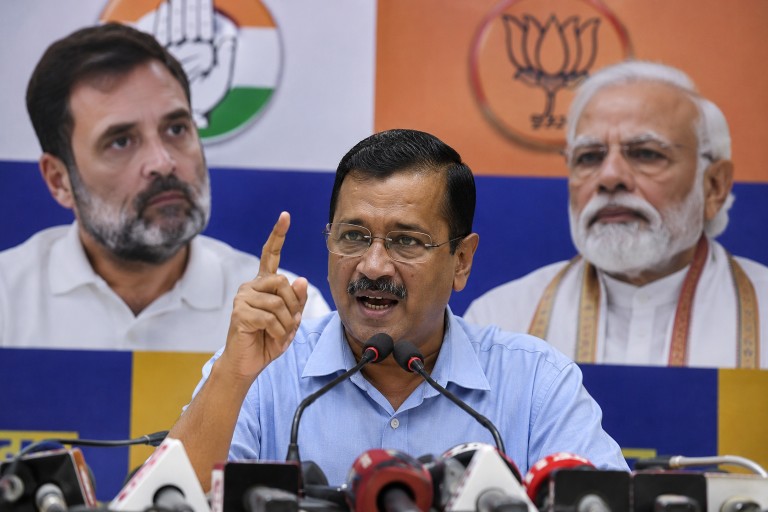
The Aam Aadmi Party (AAP) has leveled accusations against the Congress and the Bharatiya Janata Party (BJP), suggesting that the two parties are working together following a protest by Congress leader Rahul Gandhi. The demonstration, which took place near the Prime Minister’s residence, was in response to the ongoing controversy surrounding the National Eligibility cum Entrance Test (NEET).
Sanjay Singh, a Member of Parliament from AAP, criticized the government’s handling of the protest, alleging that it was permitted as a tactic to divert public attention from the student-led movement demanding accountability for the NEET paper leak. Singh suggested that such actions might undermine the broader campaign being waged by students.
Atishi, who serves as the Leader of Opposition in the Delhi Assembly, also questioned the government’s inconsistent response to protests. She pointed out that while student activists and demonstrators faced restrictions and police action near Parliament, Rahul Gandhi was permitted to protest close to the Prime Minister’s residence without facing immediate obstacles. Furthermore, she highlighted the swift government response he received, which stood in contrast to the treatment of other protesters.
The situation escalated when Union Minister Jitendra Singh met with Rahul Gandhi at the protest site, signaling the government’s willingness to discuss NEET-related issues within the framework of Parliament. Despite this, the protest concluded with the detention of Rahul Gandhi and several Congress Members of Parliament by the police.
This episode has brought to light the increasing friction among opposition parties. AAP has expressed concerns over what it perceives as unequal treatment of protests and has accused the Congress of inadvertently aiding the BJP instead of supporting the larger student movement. The incident underscores the complexities and rivalries within the opposition landscape as they navigate this contentious issue.