
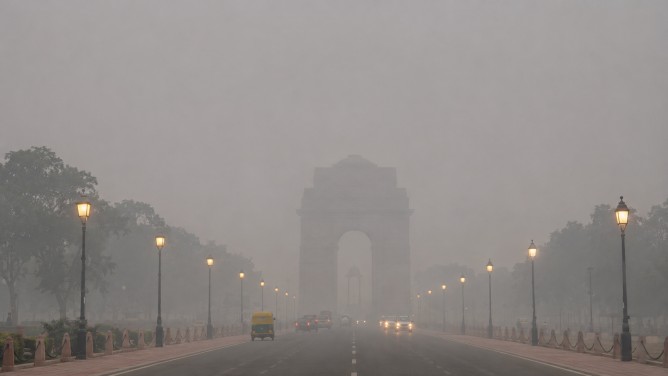
As Diwali approaches, Delhi is grappling with worsening air quality, marked by a thick haze enveloping the city on Tuesday morning. The Air Quality Index (AQI) registered at 331, categorizing the air quality as ‘very poor’. This deterioration follows a 24-hour average AQI of 324 recorded on Monday, the city’s most severe air quality in 271 days, escalating from 261 on Sunday and a significantly lower 60 on Friday.
Among Delhi’s 58 air quality monitoring stations, eight localities experienced ‘severe’ pollution levels. Areas such as Bawana, Narela, and Punjabi Bagh were notably affected, while the station at IGNOU in Maidangarhi reported moderate air quality. The Central Pollution Control Board (CPCB) identified PM2.5 as the predominant pollutant at 53 stations, with PM10 being the main concern at the remaining five locations.
The increase in pollution levels is exacerbated by farm fires, with satellite data noting 1,561 incidents across Punjab and Haryana from October 1 to November 2. Punjab accounted for the majority with 1,406 fires, while 155 were reported in Haryana, including 167 on November 2 alone.
In response to the alarming air quality, authorities have activated Stage 2 of the Graded Response Action Plan (GRAP) in Delhi-NCR. Measures include altering office hours for government and municipal employees in regions such as Delhi, Gurugram, Faridabad, Ghaziabad, and Gautam Buddha Nagar. Additionally, parking fees are being increased to discourage the use of private vehicles.
Local resident welfare associations have also been urged to provide electric heaters to security personnel to reduce open burning during the colder periods, further contributing to pollution control efforts. These steps are part of a broader strategy to mitigate the adverse effects of air pollution as the festive season approaches.